
Who arranges the choice?
Hayek, Adorno and Horkheimer meet at a record stall: dispersed knowledge, the formation of taste and the power to question the conditions of a choice.
Who can decide for us — and under what conditions can we decide for ourselves?
Through the lens of F. A. Hayek · Theodor Adorno · Max Horkheimer
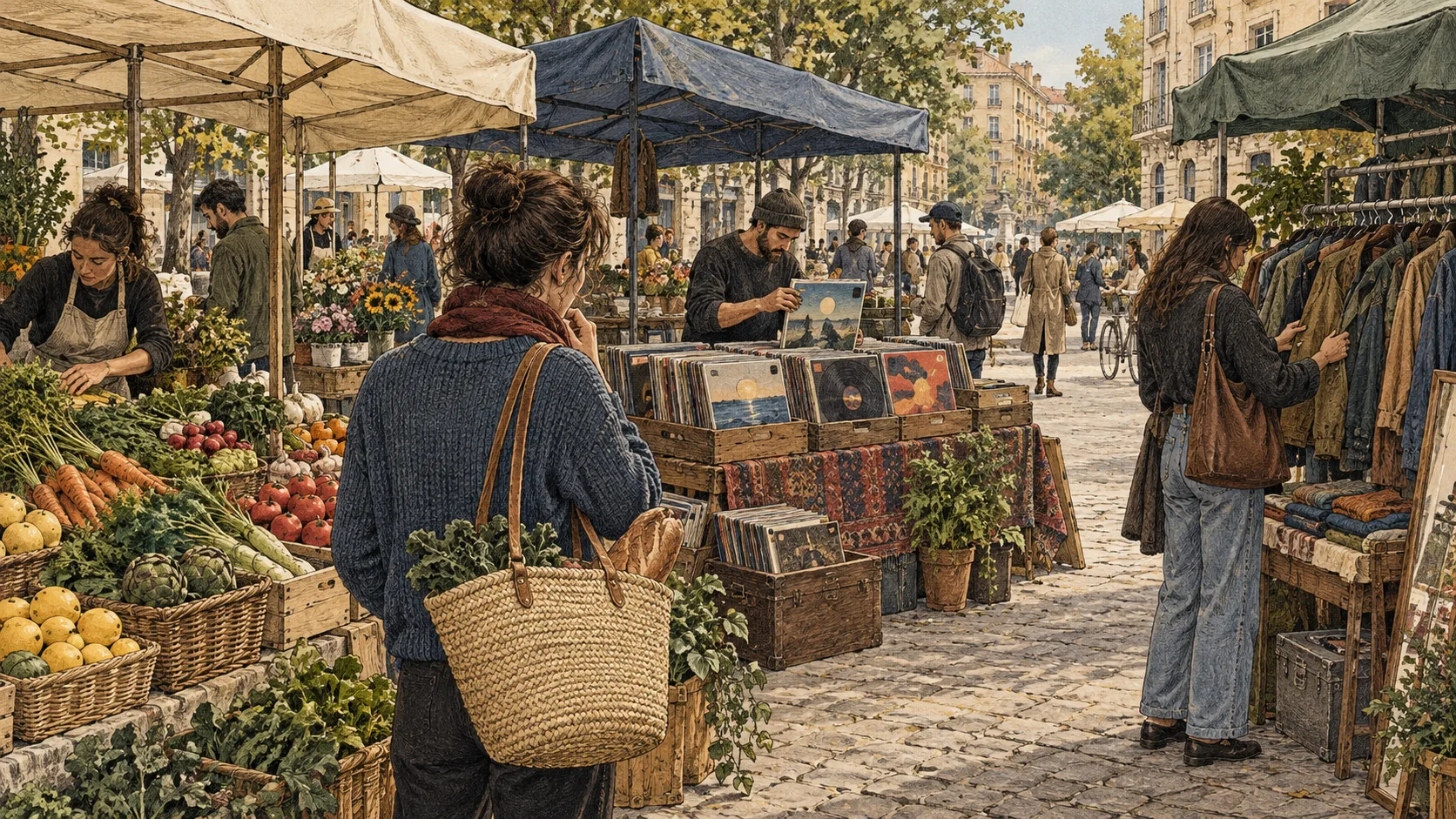
You go to the market to buy vegetables and stop at a record stall. A sleeve catches your attention. The seller plays the record, you like it and take it home. You had not planned to buy it, but the discovery was welcome.
There was a choice of yours and an encounter arranged by other people. The seller decided what to bring, display and play. You could refuse. You could also choose only among what had made its way there.
This scene brings together two traditions usually encountered as adversaries: the Austrian School of economics and the Frankfurt School. Each helps us notice something different about power and freedom.
Hayek, a major figure in the Austrian tradition, draws attention to knowledge dispersed throughout society. The greengrocer knows their suppliers; the record seller learns from customers; each buyer arrives with different needs and possibilities. Nobody holds all of this in a single mind.
His example is tin. Suppose a new use for it appears somewhere, or a source of supply is lost. Users of tin, he argues, need not know which of the two happened: the higher price tells them to economize, and tens of thousands adjust “without an order being issued”. Replacing that coordination with central command encounters a problem: whoever decides for everyone cannot assemble everyone’s knowledge.
Adorno and Horkheimer, associated with the Frankfurt School, make us look elsewhere in the scene: how do we learn to like what we like? Their critique of the culture industry examines how standardized production and the commercial circulation of culture participate in forming tastes and encouraging adaptation to existing social conditions. Variety is not their answer: “Something is provided for all so that none may escape,” they write of films and magazines sorted by price range. A variety of products can coexist with a narrow horizon of what seems desirable or possible.
That critique reaches beyond a seller’s intentions. It concerns the organization of cultural production, distribution and access. But applying it to the scene does not authorize us to conclude that the buyer’s pleasure is false. Enjoying a popular song does not prove submission. Likewise, having chosen a record does not settle the discussion about the conditions of that choice.

Here the difference between these perspectives becomes more interesting. Hayek asks what the planner cannot know; for him, the market makes use of knowledge that would escape any planner. Adorno and Horkheimer examine how society’s organization can subordinate reflection on ends to the efficiency of means; for them, market relations belong to the problem. What enables coordination in one reading can participate in domination in the other. The connection is ours; it does not make their projects versions of the same critique.
Incentives add another layer to the scene. The seller needs to sell. They may introduce something you will love and push something they need to clear from stock. Both can coincide. Knowing their commercial interest helps us understand the encounter, but does not suffice to establish manipulation.
It would also be strange to want a choice free of all influence. We learn from friends, teachers, artists and sellers. The language in which we express a preference came from other people. The market can widen our world precisely because someone brought something we would not have known to seek.
The problem arises when that influence is difficult to recognize or challenge, when alternatives cost too much, or when only some people can determine the encounter’s conditions. Saying everyone chose can then leave much unexplained.
Autonomy then involves concrete questions. You can refuse the purchase, but can the stallholder negotiate their working conditions? Who decides which sellers get a place there? When a rule harms someone, can it be discussed? Leaving may be an option for the buyer and an unaffordable loss of income for someone who depends on the stall.
The market is an imagined situation for bringing these ideas into conversation. It exposes a tension: we need forms of coordination that do not depend on someone commanding everything, and we need to question the power relations those same forms sustain.
Who can decide for us — and under what conditions can we decide for ourselves?

Sources
What changed
- — Hayek now speaks through his own example, tin, and Adorno and Horkheimer through their line on variety: "Something is provided for all so that none may escape." Two paragraphs that made the same comparison became one, and a repeated caveat was removed.
What would change our reading?
This comparison would need revision if closer readings showed that we had confused Hayek's knowledge problem with Frankfurt's critique of domination. Claims about any particular market require evidence of its rules, alternatives and effects; commercial incentives alone do not establish manipulation.